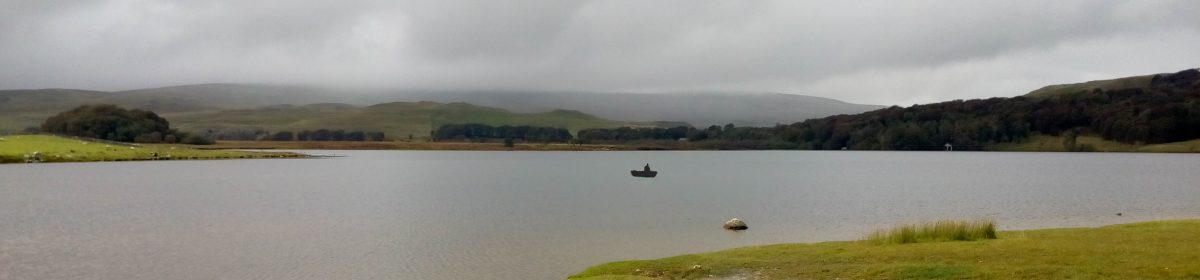
I quite like Fennel (aka Nigel Hudson) for two reasons. First he upset Mark Walsingham and some of the other Redmire brethren with a video he posted on his website, FennelsPriory. I forget what the video said but it was bland enough comment on the restoration of the lake, yet sufficient to set off Walsingham and the primadonnas who go around with cane rods up their jacksies. Which leads on to the second reason to like Fennel. He had a go at the fervent, cane-toting variety of “traditional angler” in one of his recent journals, at the same time drawing attention to some unsavoury behaviour amongst — shock, horror — members of the Golden Scale Club, a few of whom bullied the younger Fennel for using untraditional tackle, whatever that might be.
All of which prompts the question, what is traditional angling?
Tradition means something long-established, although the word has sometimes been commandeered by all manner of dubious and extreme movements. For angling, traditional is an ephemeral concept which means different things to different people, but Fennel’s criticisms, without direct mention, point to the cane-rod partisans of the Traditional Fisherman’s Forum — “For the discerning cane fisher” to avoid any doubt — of which I am a lurking member, so I have seen at firsthand what goes on there. But this collection of zealots merits its own post and I’ll say no more for now.
Fennel’s contention is that traditional angling has nothing to do with tackle or clothing. Although bamboo rods are widely held to be the tool if not the definition of the traditional angler, they’re not as old, say, as hazel rods, or those of ash, or willow. And the most traditional of traditional fishermen do not use horsehair or silkworm gut for line, or bone for hooks, or knotted cotton nets (illegal now anyway). Edwardian clothing, 1950s rods, 21st century hooks and lines, as Fennel observes. To that one might add 21st century baits; pellets are a favourite among the traditionalists, though boilies are still frowned on. At the centre of the cult traditional is the cane rod, and the true motivation is not a sensitivity to ancient ways and artisanship but a fandom for Chris Yates, noted for his partiality to split cane and tweedy clothes. Carp are the favoured fish because Yates caught the record.
According to Fennel, traditional angling is a ‘mindset,’ which sounds rather American to me (a US psychologist coined the term). He has taken the idea further than most, which he expounds on his website Fennel’s Priory. It sounds like a rehab centre, and perhaps that’s not a bad comparison, as he talks about freeing himself from the eat-work-sleep corporate culture that many of us live in. I know how he feels. His tagline ‘Stop – Unplug – Escape – Enjoy’ is beguiling but reminds me of the hippy mantra Turn on, tune in, drop out; and we know how that ‘lifestyle’ turned out.
The problem with unplugging and dropping out is age-old, or traditional if you like — lack of money. Somehow we have to earn a crust, even if that crust is a modest one. Fennel is candid on his blog and relates some difficult personal times. Recently he has been forced to return to company employment to make a living, his writing not able to generate sufficient income. The notion of being a countryman, an outdoorsman is really a romance. Few people are in this category nowadays: examples are farmers, gardeners (which Fennel once was), road sweepers, all quite arduous occupations and mainly low paid; they certainly don’t wander round the countryside sniffing wild flowers, whittling on sticks and writing pastoral poetry. The wealthy green-welly bourgeoisie in Range Rovers, tattersall shirts and cords love to pose as countryfolk but apart from their big houses beyond the suburbs they are as country as Buckingham Palace gardens. Few now would really want to be traditional countrymen: through the centuries their short lives were characterised by poverty, hunger and fear. So what does Fennel mean by a ‘natural life’? One that ‘helps us to escape, find freedom and have adventures,’ he says, redolent of Enid Blyton. The closest I can imagine to his idea of a natural life is one in which I’d have a secure income and only need to work to satisfy my own interests and fill in the time between fishing (I wouldn’t want to fish every day). I have met at least one person who inherited enough to live this life. Alas, I’m not in that position.
Fennel’s blog is a gentle meandering read, more interesting than most blogs about fishing. He admits he is in thrall to Chris Yates too, and Bernard Venables gave his website, his outlook, its name. This especially shows in some of his writing, the habit of telling us where he sits with notepad — at his desk, under a tree, barefoot on the lawn. There is inevitably an unrealism in the dreams of nature escape yet perhaps it is worth striving for; Fennel strives better than most and his reflections are engaging, avoiding the excesses that characterised the late Venables style in his journey back to the Garden. Maybe Fennel will move away from the Yatesian view, which seems slightly schoolboy to me, and give us more of his heretical thoughts, provided he can weather his time under canvas, somewhere in Dorset.
Where does this leave the traditional fisherman? If we consider that people in the ancient world fished with rod and line, then all angling is traditional, so there is no need for distinctions. Some bamboo professors, however, believe they are more traditional than others. A fancy has become a faith, and the faithful have a habit of turning on each other.
 The Secret Angler