
The current BBC programme, Trawlermen: Hunting the Catch makes clear why sea anglers, especially shore anglers, have such lean pickings. The fishing grounds around the British Isles are trawled by numerous commercial fishing boats, often several at the same time in one small area. Last year there were 4269 trawlers operating from the UK. Then there are the overseas trawlers, including about 25 supertrawlers (over 100 meters long) which are capable of netting hundreds of tonnes of fish each day. These may legally fish protected areas.
Some idea of the fishing pressure can be viewed on the globalfishingwatch website.

Fish are never evenly spread. In the relatively small areas where they’re found they are subject to relentless fishing pressure, in spite of quotas and rules governing allowable fishing days. Monkfish, cuttlefish, prawns and all the rest of the commercial species are caught in great numbers; hundreds of boxes are filled and sold at auction onshore.
The harm to the marine environment is not just a matter of overfishing. Scallop areas are ploughed over by the shellfish dredgers, damaging habitat for both scallops and other species.
Technology lies behind much of the overfishing. Huge trawlers can now catch many tonnes of fish in one trip. A striking example is the mackerel trawler with the gear to net huge quantities in one sweep. In the programme it caught 1300 tonnes of fish, sold to an Asian sushi buyer on the continent for £1 million. Mackerel is the top species landed by UK boats, 209,000 tonnes in 2021.
Commercial fishing is clearly big business and skippers can earn as much as £100,000 a year. Only in the City are you likely to find those levels of incomes. Even the deckhands can do very well financially. On one of the programmes a crabber said how he once boasted to his teacher that he earned more money than them aged 15. Mind you, it is a dangerous job and earnings depend on finding plenty of fish, which is becoming more and more difficult.
Not surprising then that the UK commercial catch in 2020 was 623,000 tonnes, a value of £831 million. Despite quotas many species are still overfished. The graph below is the ICES assessment of mackerel stocks (the SSB or spawning stock biomass) since 1980. Unusually mackerel have seemed to fare relatively well, numbers increasing from 2007, but falling in recent years.

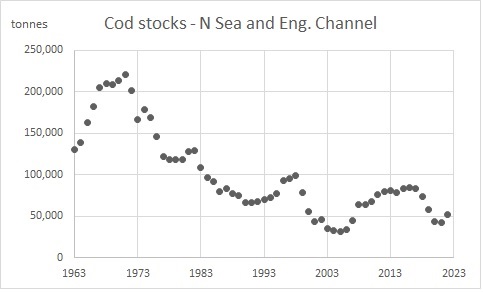
I and other anglers have noticed how fewer the mackerel are now during summer. The greater focus on mackerel as a sustainable fishery may mean more intensive fishing is reducing the population. Whatever the reason, numbers are dropping, though still not to the parlous level of cod, the most important commercial species. Since the 1970s cod stocks have declined, bumping up a little a decade ago due to stricter quotas, before declining again.
Back in 1988 John Holden wrote, ‘Without cod, sea fishing would nosedive into oblivion.’ The graph shows that stocks had already declined a long way, and although you’ll still see anglers on the beach, not many cod are caught, even from deep marks like Chesil, and oblivion looks to be the future.
I rarely go sea fishing now. Even fishing from a boat, which gives you a much better chance of a cod or anything else, means a long sail to find them. Two hours was a typical journey, often for only modest catches.
Marine Conservation Zones may eventually contribute to improved stocks but commercial interests are strong. Even anglers complain about restrictions on their fishing and those being introduced to bait digging, despite being ultimately in our interests. Climate change will also have an impact. Warming seas will displace cod northwards, although bass may become more numerous, if they are not fished to oblivion too.
Anglers of all kinds have a lot to worry about but too many are not worried enough. Rivers are polluted by agriculture and sewage; seas are overfished and polluted. We can do our bit by supporting and contributing to environmental initiatives, and not eating farmed fish unless grown sustainably (look for the ASC label), especially salmon. Feed pellets are manufactured from sea fish, notably sandeels, sardines and other small marine species, important parts of the food chain. Aquaculture, apparently a replacement for wild fish, contributes to pollution and overfishing too. We cannot pretend otherwise.

 The Secret Angler